


 PLATFORM UPDATE:

Insight into multivalent iron complex-bound oxygen vacancy-rich BiOBr nanodiscs for photocatalytic ammonia synthesis
 †a
Himani
Joshi,
†b
Naveen
Sharma,
b
Srimanta
Pakhira
*bc
and
Santanu
Bhattacharyya
*a
†a
Himani
Joshi,
†b
Naveen
Sharma,
b
Srimanta
Pakhira
*bc
and
Santanu
Bhattacharyya
*a
Abstract
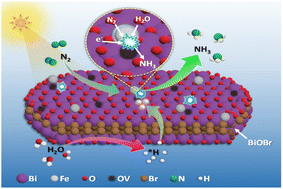
Photocatalytic conversion of N2 to green NH3 has become extremely promising as an alternative to the traditional Haber–Bosch process for a resilient future. In this context, developing noble metal-free nanomaterials with highly efficient photocatalytic activity is highly demanding. Herein, oxygen vacancy-rich disc-shaped BiOBr (BOBOV) has been synthesized, and a multivalent Fe–phytic acid complex has been further coupled with it to form the final composite – BOBOV@Fex. It is utilized for photocatalytic NH3 production from N2, and further compared with other controlled samples. Detailed structural and elemental properties have been correlated with the intrinsic optoelectronic properties. The results suggest that the coupling of the Fe complex acts synergistically with the oxygen vacancies (OVs), which improve the visible light absorption, charge separation, and N2 adsorption. It eventually elevates the photocatalytic efficiency. The photocatalytic efficiency for the optimized samples reaches up to 385.5 µM gcat.−1 h−1 with an AQE of 5.24%. It has been thoroughly supported by a series of computational studies. Quantum mechanical calculations employing the PBE-D method are utilized to provide the crucial role of polyvalent Fe atoms and OVs on the surface of BOB for N2 activation. Thermodynamic analysis further confirms that the N2 reduction proceeds most favorably through the associative distal pathway.
- This article is part of the themed collection: Celebrating International Women’s Day 2026: Women in Journal of Materials Chemistry A
 Please wait while we load your content...


