


 PLATFORM UPDATE:


Proton source selective semi-hydrogenation of alkynes: a water-powered selective photocatalyst based on nickel single-atoms on poly(heptazine imide)
 a
Marcos Augusto
Ribeiro da Silva,
a
Vitor
Gabriel da Silva Pastana,
a
José Balena
Gabriel Filho,
b
Benedict T. W.
Lo,
d
Paolo
Ghigna,
eg
Maurizio
Fagnoni,
e
Luca
Braglia,
f
Davide
Ravelli,
e
Ivo Freitas
Teixeira
*a
a
Marcos Augusto
Ribeiro da Silva,
a
Vitor
Gabriel da Silva Pastana,
a
José Balena
Gabriel Filho,
b
Benedict T. W.
Lo,
d
Paolo
Ghigna,
eg
Maurizio
Fagnoni,
e
Luca
Braglia,
f
Davide
Ravelli,
e
Ivo Freitas
Teixeira
*a
Abstract
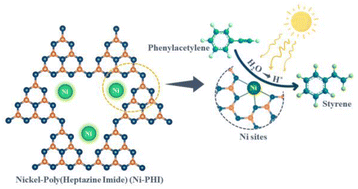
Despite recent advances in photocatalytic hydrogenation reactions using water as a hydrogen source, many existing systems still suffer from limited efficiency, reliance on noble metals, or require complex synthetic procedures. Developing robust, earth-abundant, and synthetically accessible photocatalysts remains a major challenge in the pursuit of sustainable chemical transformations. In this work, we report the preparation of a single-atom nickel photocatalyst embedded in poly(heptazine imide) (Ni-PHI) via a simple and versatile cation exchange strategy. This noble-metal-free photocatalyst enables the selective semi-hydrogenation of alkynes under visible light irradiation using water as the proton source. Photocatalytic tests with phenylacetylene demonstrated a conversion exceeding 98% and a high selectivity for styrene. Moreover, the protocol could be extended to other (internal) alkynes with different substituents. Mechanistic investigations revealed that water molecules adsorb onto Ni(II) sites, promoting a transition from high-spin to low-spin state of the metal center. Under visible-light irradiation, the photogenerated electrons promote the formation of a Ni(I) species, which facilitates proton transfer to the substrate. Spectroscopic studies using near-edge X-ray absorption fine structure (NEXAFS) and multiplet calculations were used to elucidate the reaction mechanism.
- This article is part of the themed collection: Journal of Materials Chemistry A HOT Papers
 Please wait while we load your content...


