


 PLATFORM UPDATE:


Interfacial modulation of BiVO4 photoanodes with SnO2 quantum dots and FeOOH for efficient solar-driven water oxidation

Abstract
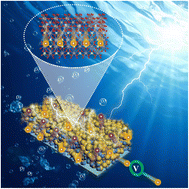
Addressing the global energy crisis, photoelectrochemical water splitting offers a sustainable route for solar-to-hydrogen conversion. Herein, we present a BiVO4-based photoanode synergistically modified with (tin dioxide) SnO2 quantum dots (QDs) and a FeOOH cocatalyst to overcome efficiency-limiting bottlenecks. The optimized BiVO4/SnO2 QD/FeOOH system achieves a photocurrent density of 3.92 mA cm−2 at 1.23 VRHE under AM1.5G, marking a 2.46-fold enhancement over pristine BiVO4, coupled with a 140 mV cathodic shift. In situ XPS and theoretical calculations reveal that a built-in electric field forms between BiVO4 and SnO2 QDs. This field drives hole accumulation at the BiVO4 interface near the SnO2 QDs, thereby enhancing the surface photovoltage. These findings offer insights into improving the utilization efficiency of hole carriers at the photoanode surface, significantly enhancing charge separation and transfer. First-principles calculations show that SnO2 QD incorporation induces interfacial charge redistribution and enhances the electronic conductivity in BiVO4. Furthermore, the FeOOH overlayer, as demonstrated in recent studies, simultaneously enhances charge transfer kinetics, mitigates surface corrosion, and accelerates the oxygen evolution reaction. This dual-functional interfacial engineering strategy integrates quantum dot-mediated electronic modulation with catalytic surface activation, addressing critical challenges of charge recombination and sluggish water oxidation in BiVO4. The work establishes a rational co-modification paradigm for developing robust semiconductor photoelectrodes, emphasizing interfacial defect control and catalytic synergy for efficient solar energy conversion.
 Please wait while we load your content...


