


 PLATFORM UPDATE:


Bioinspired poly(acrylic acid)-regulated crosslinked self-healing, quasi-solid polymer electrolytes for flexible supercapacitor applications

Abstract
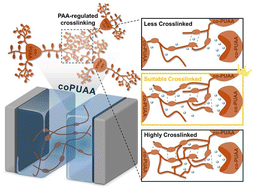
The increasing demand for efficient power solutions in portable and wearable electronics has highlighted flexible supercapacitors as a critical energy storage technology, offering high-power density, exceptional cycle life, and enhanced safety. Inspired by biomimetic design strategies, which have increasingly been employed to enhance the mechanical integrity of materials, this study adopts a bio-inspired approach to develop a structurally stable architecture through synthetic modification. We introduce a self-healing quasi-solid polymer electrolyte (QSPE) that addresses the limitations of conventional gel electrolytes by leveraging poly(acrylic acid) (PAA) for enhanced electrolyte retention and self-repair capabilities. Incorporating PAA facilitates the strong hydrogen bonding networks and optimizes the crosslinking density, achieving compatibility between mechanical robustness and ion transport. In this research, synaptic-inspired coPUAA330 has been identified as the most ideal composition. When integrated into supercapacitors soaked with tetraethylammonium tetrafluoroborate (TEABF4) in propylene carbonate (PC) as the electrolyte, the cell with coPUAA330 retains nearly 96% of its initial capacitance, even in relatively high water-content organic electrolytes. Furthermore, after undergoing cutting and self-repair, it retains 91% of its capacitance, demonstrating the strong self-healing ability. Additionally, the cell preserves 70% of its capacitance after 3000 charge–discharge cycles, highlighting its excellent cycling stability. Notably, flexible devices utilizing coPUAA330 exhibit stable capacitance retention up to a bending angle of 135° and retained 78% of their capacitance upon returning to their original state. These findings establish coPUAA330 as a high-performance, self-healing QSPE with exceptional mechanical flexibility and electrochemical reliability, reinforcing its potential for next-generation flexible supercapacitors.
- This article is part of the themed collection: Supercapacitors for a sustainable energy future
 Please wait while we load your content...


