


 PLATFORM UPDATE:


Pentavalent Ta-substitution enhances ionic conductivity and critical current density in NASICON for sodium-ion batteries†

Abstract
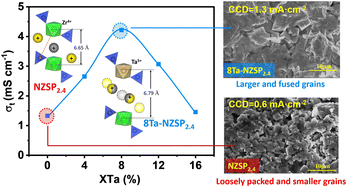
NASICON-type materials are promising electrolytes for all-solid-state sodium-ion batteries (ASSSBs); however, the role of pentavalent dopants (V5+, Nb5+ and Ta5+) in Na3Zr2Si2PO12 (NZSP) remains insufficiently understood. Among pentavalent dopants, having the widest bandgap, Ta5+ doped NZSP shows tremendous promise as an ionic conductor with good electronic insulation. In this study, we report a pentavalent Ta-substituted NASICON electrolyte, Na3.32Zr1.92Ta0.08Si2.4P0.6O12 (8Ta-NZSP2.4), which exhibits excellent room-temperature total and grain conductivities of 4.26 and 8.84 mS cm−1, respectively. First-principles calculations reveal that, despite the smaller ionic radius of Ta5+ (∼0.64 Å) relative to Zr4+ (∼0.72 Å), Ta substitution facilitates Na+ vacancy formation, widens diffusion bottlenecks, and promotes correlated ion migration, reducing the activation barrier to 0.155 eV. Symmetric Na|8Ta-NZSP2.4|Na cells cycled stably for over 1000 cycles at 0.2 mA cm−2 while maintaining low overpotentials (<15 mV) and no soft shorting. The critical current density of NZSP2.4 also increased from 0.6 to 1.3 mA cm−2 upon Ta substitution. A Na|8Ta-NZSP2.4|Na3V2(PO4)3 full cell retained 89.5% of its specific capacity when operated at 0.3C for 100 cycles at room temperature with no additional stack pressure applied. These results deepen the fundamental understanding of pentavalent-doped NASICON electrolytes and position 8Ta-NZSP2.4 as a promising candidate for practical ASSSBs.
- This article is part of the themed collection: Celebrating International Women’s Day 2026: Women in Journal of Materials Chemistry A
 Please wait while we load your content...


