


 PLATFORM UPDATE:


Essential role of temperature-dependent band gaps in (p × n)-type transverse thermoelectrics: partial gap analysis of Re4Si7
 †a
Juncen
Li,
†b
Charles J.
Zeman, IV,
e
Martín A.
Mosquera,
e
Leighton O.
Jones,
e
George C.
Schatz,
e
Jiong
Yang
d
and
Matthew A.
Grayson
*ac
†a
Juncen
Li,
†b
Charles J.
Zeman, IV,
e
Martín A.
Mosquera,
e
Leighton O.
Jones,
e
George C.
Schatz,
e
Jiong
Yang
d
and
Matthew A.
Grayson
*ac
Abstract
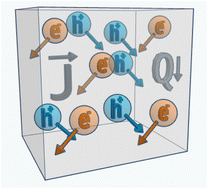
Transverse thermoelectrics (TTE) have attracted attention as versatile energy materials where heat flows perpendicular to an applied electrical current due to structural asymmetry. Semiconductors and semimetals can exhibit TTE-behavior due to mixed conduction of anisotropic electron and hole dispersions with p- and n-type behavior in orthogonal crystal directions, hence (p × n)-type TTEs. But in spite of a dozen such materials being discovered in the last decade, their experimental data still do not quantitatively fit a transport model across the measured temperature range T, partly because mixed anisotropic conduction is challenging to characterize. Without proper understanding of the fundamental structure–properties relationship, such materials cannot achieve their optimal performance. Here, a partial-gap analysis based on the Peltier conductivity is introduced which leverages the anisotropy of these materials to ‘unmix’ the electron–hole conduction and self-consistently extract the energy gap at each temperature, revealing a strong T-dependence that had been previously neglected. The method is demonstrated on Re4Si7 since it has been independently measured by two different research groups. In spite of the differences in the raw data of these contrasting datasets, the analysis nonetheless provides nearly identical predictions for the T-dependent energy gap, which decreases by half over the measured thermal range. In general, such TTE materials possess small or negligible energy gaps that can change with temperature by an amount comparable to the gap, itself, highlighting the importance of quantifying this T-dependence. The results for Re4Si7 are also shown to be in quantitative agreement with electron–phonon renormalized density functional theory. This analysis establishes the importance of understanding T-dependent gaps in properly modeling the TTE structure–properties relationship.
 Please wait while we load your content...


