


 PLATFORM UPDATE:


Water exotic states are responsible for the hydrovoltaic effect and controllable evaporation over carbon fibers – spectroscopic and thermodynamic studies

Abstract
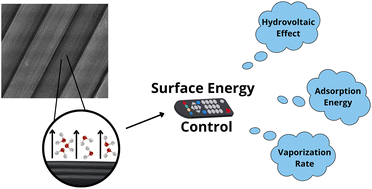
Carbon materials dominate among materials applied in hydrovoltaic energy-generating and photothermal conversion devices as Janus evaporators. This work investigated the hydrovoltaic effect and photothermal conversion on gradually oxidized carbon fibers (CFs). We used the controllable and unique properties of the tested materials, such as conductivity and mechanical and surface properties, to explain the mechanism of water interaction with the CF surface. With known changes in the specific surface area of CFs, we could directly correlate changes in polarity, enthalpy, or acidity of surface energy components with exotic structures of water clusters. We have proven experimentally that these structures are responsible for the observed phenomena. The increase in surface polarity is the direct cause of the increase in the strength of the electrostatic field at the surface, which for the most oxidized fibers is 4.22 GV m−1. Such a high field intensity value immobilizes water clusters. Reducing the surface electrostatic field intensity to 1.3 GV m−1 causes a significant reduction of the Stern layer, and its complete disappearance occurs for the sample with 0.35 GV m−1. The higher the electrostatic field, the higher the hydrovoltaic effect observed. Water adsorption enthalpy, especially at high relative humidity, is also correlated with the observed phenomena. Stronger interaction of water with the CF surface is not beneficial for a strong stream of water vapor in the evaporator (4.67 kg m−2 h−1). The strongest vapor stream (equal to 7.10 kg m−2 h−1) was observed for the sample with 1.3 GV m−1, for which water adsorption enthalpy values decrease to a minimum at high relative pressure.
 Please wait while we load your content...


