


 PLATFORM UPDATE:

Durability and degradation of Anion Exchange Membranes in water electrolyzers†

Abstract
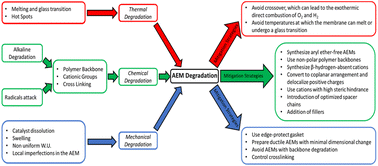
Anion Exchange Membrane Water Electrolyzers (AEMWEs) have emerged in recent years as an attractive alternative to Proton Exchange Membrane Water Electrolyzers (PEMWEs) and Alkaline Water Electrolyzers (AWEs) to produce hydrogen, thanks to the possibility of using cost-effective catalyst materials and less expensive and non-fluorinated Anion Exchange Membranes (AEMs). The major drawback of these systems is the limited durability of AEMs because of mechanical, thermal and chemical degradation, which are influenced by the operating parameters (temperature and pressure) of the AEMWE device. Chemical degradation is, especially, the most severe due to the highly alkaline operating environment of AEMWEs. Investigating the causes of these failures is crucial for optimizing the AEM stability. This review focuses on the degradation mechanisms involved and on possible strategies to mitigate them. An overview of the working principles of AEMWEs is provided, together with the state-of-the-art and the main functional properties of AEMs. Also, the most used cationic functional groups and polymer backbones are analysed along with their degradation pathways.
- This article is part of the themed collection: Journal of Materials Chemistry A Recent Review Articles
 Please wait while we load your content...


