


 PLATFORM UPDATE:


Cu-decorated Sc2CFN monolayer for efficient CO2 capture and activation

Abstract
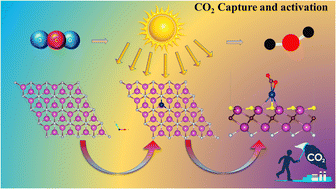
The efficient reduction of CO2 is essential for mitigating carbon emissions and advancing sustainable energy technologies. In this study, we explore the potential of the Sc2CFN monolayer as a photocatalyst for CO2 capture and activation. This two-dimensional material exhibits an indirect band gap of 0.91 eV, making it a promising candidate for photocatalytic applications. Through adsorption energy analysis, we identified key active sites on the pristine Sc2CFN monolayer, where CO2 adsorption energies were determined to be −0.41 eV, −0.20 eV, and −0.76 eV. Notably, the nitrogen site demonstrated the strongest adsorption affinity (−0.76 eV) for CO2 in a horizontal configuration. To enhance catalytic efficiency, we incorporated copper (Cu) doping, which significantly improved CO2 adsorption at the nitrogen site, increasing the adsorption energy to −2.21 eV while inducing a CO2 tilting angle of 144.4°. Hirshfeld charge analysis and charge density difference plots suggest substantial Cu–CO2 interactions by confirming increased charge transfer at the N and Sc + N locations. These locations promote effective CO2 activation because they show the highest average charge buildup. These results underscore the potential of Cu-doped Sc2CFN monolayers as highly efficient photocatalysts for CO2 capture and activation, offering a promising strategy for sustainable energy conversion and storage.
 Please wait while we load your content...


