


 PLATFORM UPDATE:


Can solvothermal synthesis drive defectivity and unlock better electrochemical performance in Li-rich layered oxides?
 *a
Eric
Hirschmann,
f
Andreas
Wagner,
f
Maria Assunta
Navarra,
a
Sergio
Brutti
a
and
Laura
Silvestri
*b
*a
Eric
Hirschmann,
f
Andreas
Wagner,
f
Maria Assunta
Navarra,
a
Sergio
Brutti
a
and
Laura
Silvestri
*b
Abstract
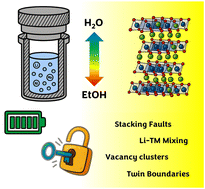
This study highlights a novel perspective on the role of defectivity in governing the electrochemical performance of cobalt-free lithium-rich layered oxides (LRLOs), specifically Li1.24Mn0.62Ni0.14O2. By varying the solvent environment during solvothermal synthesis, using binary mixtures of water and ethanol, we demonstrate that the nature of the solvent profoundly influences defect formation within the material. These solvent-dependent defect structures emerge as the key drivers of electrochemical behavior, rather than just crystallinity or composition. Through advanced characterization techniques including synchrotron X-ray diffraction, electron diffraction, transmission electron microscopy, and positron annihilation lifetime spectroscopy, we reveal how each solvent system tailors specific microstructural and defect profiles. Despite identical nominal compositions, these variations in defectivity lead to remarkable different electrochemical performances: higher ethanol content promotes small vacancies and electronic defects, boosting initial capacity but reducing stability, while lower ethanol fractions favour larger vacancies and stacking faults, yielding more balanced performance. Our findings underscore the critical role of solvent selection in tuning defect chemistry, offering a new pathway for optimizing LRLO materials by intentionally controlling defect landscapes during synthesis.
- This article is part of the themed collection: Celebrating International Women’s Day 2026: Women in Journal of Materials Chemistry A
 Please wait while we load your content...


