


 PLATFORM UPDATE:


Revealing the role of functional binder PEDOT:PSSTFSI in cathode–electrolyte interphase formation on LiFe0.4Mn0.6PO4 electrodes of Li-ion batteries
 abde
Delphine
Flahaut,
*cde
Jacob
Olchowka,
ade
Cyril
Brochon,
b
Éric
Cloutet
*b
and
Laurence
Croguennec
*ade
abde
Delphine
Flahaut,
*cde
Jacob
Olchowka,
ade
Cyril
Brochon,
b
Éric
Cloutet
*b
and
Laurence
Croguennec
*ade
Abstract
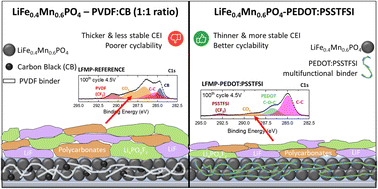
The stability of the cathode–electrolyte interphase (CEI) plays a critical role in determining the long-term performance of Li-ion batteries, particularly under high-voltage operation. This work investigates CEI formation and evolution in LiFe0.4Mn0.6PO4 (LFMP) composite positive electrodes using PEDOT:PSSTFSI, a conductive polymer that replaces both carbon black and polyvinylidene fluoride (PVDF) binder in the electrode formulation. Electrochemical tests, XRD, and XPS confirm PEDOT:PSSTFSI's electrochemical stability up to 4.5 V vs. Li+/Li and non-reactivity towards the active material. Reversible redox activity is observed in XPS, but it does not affect long-term structural or electrochemical stability. XPS analysis of C 1s, O 1s, P 2p, and F 1s spectra across different charge states reveals that PEDOT:PSSTFSI promotes a thinner, more stable CEI without altering its composition compared to carbon-containing references. This reduced interfacial degradation corresponds with improved performance at higher voltages during extended cycling. The results underscore PEDOT:PSSTFSI's promise as a multifunctional binder offering conductivity, stability, and interfacial control for advanced Li-ion positive electrodes.
 Please wait while we load your content...


