


 PLATFORM UPDATE:


Theoretical investigation on the dendrite suppression and desolvation promotion effect of the coating material on the Zn metal anode for aqueous zinc-ion batteries: case study of oxide coating

Abstract
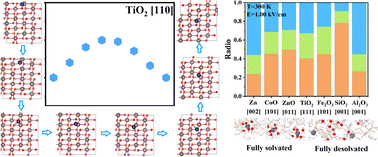
Interfacial engineering via oxide coatings offers a promising strategy to improve the electrochemical performance and cycling stability of aqueous zinc-ion batteries (AZIBs). Here, we develop a multiscale theoretical framework combining ab initio density functional theory (DFT) and classical molecular dynamics (MD) simulations to systematically investigate the effects of representative oxide coatings—α-SiO2, α-Al2O3, α-TiO2, α-ZnO, α-Fe2O3, and α-CoO—across multiple crystallographic facets on Zn surface chemistry, ion transport behavior, and Zn2+ desolvation dynamics. DFT calculations reveal that the TiO2 [110] surface exhibits ultralow Zn diffusion barriers on the order of hundreds of millielectron volts, in sharp contrast to the substantially higher barriers on Al2O3 and CoO (a few electron volts) and on ZnO and SiO2 (exceeding ten electron volts), indicating excellent ion mobility and potential for dendrite suppression. Complementary MD simulations demonstrate that Zn2+ desolvation is strongly modulated by oxide surface chemistry, temperature, and external electric fields. In the absence of an electric field, the SiO2 [001] surface induces an exceptionally high desolvation ratio of ∼81% at room temperature, far exceeding that of the bare Zn surface (∼20%) and the moderate desolvation ratios (∼40%) observed on CoO [101], ZnO [011], TiO2 [111], and Fe2O3 [101]. These results identify SiO2 as a superior coating material—consistent with experimental observations—for stabilizing Zn anodes through its ultrahigh desolvation capability. In contrast, TiO2, Al2O3, and CoO offer a balanced combination of moderate desolvation efficiency and low Zn diffusion barriers, supporting fast ion transport and high-rate capability. Overall, this work establishes a predictive framework for the rational design of oxide-based interfacial layers, providing mechanistic insights to guide the development of durable and high-performance AZIB systems.
 Please wait while we load your content...


