


 PLATFORM UPDATE:


Si-doped vanadium pentoxide/graphene xerogel nanocomposite cathodes with excellent cycle life for Li-ion batteries

Abstract
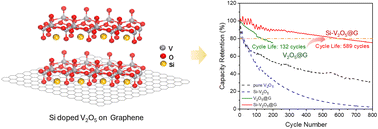
Vanadium pentoxide (V2O5) is a promising cathode material for lithium-ion batteries due to its high theoretical specific capacity (443 mA h g−1) and specific energy (1218 Wh kg−1 at 2.75 V). However, its large-scale application is limited by its poor electrical conductivity and structural instability, leading to irreversible capacity loss, consequently, short cycle life, and low-rate capability. In this work, we developed a 3D nanostructured xerogel composite by uniformly doping silicon (Si) into the V2O5 framework, which anchors on the surface of graphene sheets via a sol–gel process. The optimized Si-doped V2O5 on the graphene (Si-V2O5@G) composite, containing 10 wt% Si and 2 wt% graphene, delivers a high specific capacity of 392 mA h g−1 at 0.1C rate and excellent cycling stability: 589 cycles with 80% capacity retention at a high rate of 1.0C, and a very low capacity fading rate of 0.03% capacity loss per cycle—significantly surpassing the best performance of up-to-date V2O5 work (e.g. the best performance of 160 mA h g−1 and 300 cycles at 0.75C rate and 0.13% capacity loss per cycle). Scanning Transmission Electron Microscopy (STEM) reveals uniform Si distribution, which leads to much larger V2O5 nanoribbons over the graphene sheets (observed using TEM). Such a nanocomposite structure is capable of tolerating more structural change during the (de)lithiation process, resulting in a much improved cycle life. Electrochemical impedance spectroscopy (EIS) and cyclic voltammetry (CV) further demonstrate the improved conductivity and structural integrity. X-ray photoelectron Spectroscopy (XPS) manifests the interaction of doped Si with the V–O system. The in operando XANES and EXAFS analyses suggest the increased multi-valence change among V5+, V4+, and V3+ states in the (de)lithiation process after Si-doping. Additionally, EXAFS analysis indicates that Si doping effectively stabilizes the local V–O coordination environment, facilitating better Li+ insertion/extraction reversibility and reducing the degradation of Si-V2O5@G systems. This work demonstrates a cost-effective, non-metal doping strategy for enhancing the electrochemical performance of high-energy-density metal oxide cathodes for next-generation LIBs.
 Please wait while we load your content...


