


 PLATFORM UPDATE:


Atomically precise Au42 and Cu-doped Au42 nanorods for CO2 reduction: the critical role of ligand removal

Abstract
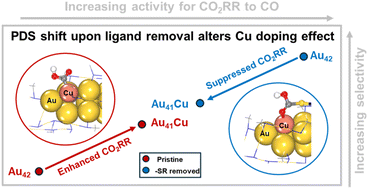
Atomically precise nanoclusters (APNCs) of coinage metals provide a powerful platform for elucidating structure–property relationships in catalysis due to their well-defined atomic structures. In this study, we investigate the electrocatalytic behavior of the rod-shaped Au42(SR)32 nanocluster and its copper-doped derivatives for the carbon dioxide reduction reaction (CO2RR) and competing hydrogen evolution reaction (HER). By integrating density functional theory (DFT) calculations with electrochemical measurements, we demonstrate that ligand removal has a profound impact on catalytic activity and selectivity by altering the nanocluster's electronic structure and active sites. Among the ligand-modified configurations, the –SR removed Au42(SR)32 nanocluster exhibits the most favorable CO2RR performance, with significantly lower overpotentials and enhanced selectivity. While Cu doping can improve activity and selectivity in the pristine and –R removed nanoclusters, it reduces performance in the –SR removed nanocluster due to a shift in the potential-determining step (PDS) from *COOH formation to *CO desorption after Cu doping. The DFT predicted onset potentials for CO2RR and HER show excellent agreement with electrochemical experiments. Additionally, X-ray photoelectron spectroscopy (XPS) analysis confirms ligand stripping during reductive electrolysis. While site specific Cu doping remains to be achieved experimentally, our findings underscore the critical role of dynamic ligand behavior under operating conditions in the rational design of high-performance APNC-based electrocatalysts for CO2 conversion.
 Please wait while we load your content...


