


 PLATFORM UPDATE:


Morphology-controlled Fe3O4@CNF nanocomposites for sustainable paper-based energy storage with recyclability

Abstract
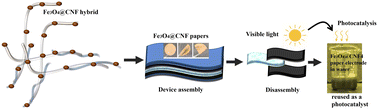
Flexible, biodegradable and paper-based supercapacitors derived from eco-friendly materials have emerged as promising candidates for next-generation wearable and portable electronics. In this study, we report the development of Fe3O4-decorated cellulose nanofiber (Fe3O4@CNF) nanocomposites synthesized via an interfacial deposition strategy. Here, cellulose nanofibers (CNFs) serve as a sustainable and naturally derived scaffold, enabling uniform nucleation and growth of Fe3O4 nanoparticles (NPs). Among four compositions investigated, Fe3O4@CNF4 exhibited optimal structural integrity and outstanding electrochemical characteristics. The binder-free, freestanding paper electrodes—fabricated without additional conductive agents—demonstrated a high specific surface area (79 m2 g−1), interconnected hierarchical porosity, excellent flexibility, and enhanced electrical conductivity. Symmetric supercapacitor devices assembled using Fe3O4@CNF4 were evaluated in both aqueous and solid-state electrolytes. The devices delivered remarkable specific capacitance (Cs) of 200 F g−1 (aqueous) and 188 F g−1 (solid-state), with corresponding energy densities of 36.9 Wh kg−1 and 33 Wh kg−1, while retaining 92% and 97.9% of their initial capacitance after 8000 charge–discharge cycles, respectively. In addition to their energy storage capabilities, Fe3O4@CNF4 electrodes exhibited excellent photocatalytic performance, achieving 95% degradation of crystal violet under visible light within 45 min, thus demonstrating a dual-functionality approach. This work introduces a sustainable, high-performance nanocomposite for flexible supercapacitors and highlights its potential in environmental remediation through photocatalysis, positioning Fe3O4@CNF materials as a compelling platform for multifunctional energy and environmental technologies.
 Please wait while we load your content...


