


 PLATFORM UPDATE:

Enhanced catalytic turnover and robustness of laccase from Trametes pubescens through carrier-free aggregation

Abstract
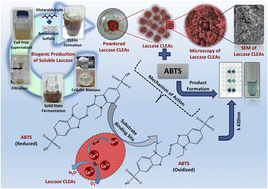
Green biocatalysis has revolutionized industrial processing by replacing whole-cell systems with robust immobilized biocatalysts, significantly streamlining downstream purification. This study reports the fabrication and biocatalytic characterization of carrier-free Crosslinked Enzyme Aggregates (CLEAs) using laccase produced by the white rot fungus Trametes pubescens through solid state fermentation. The resulting L-CLEAs exhibited superior thermal robustness and catalytic performance compared to the soluble laccase (SL). Kinetic analysis revealed that while the apparent substrate binding affinity (Km) increased 5.4-fold due to mass transfer limitations, this was also largely compensated for by a 4.1-fold enhancement in the catalytic rate constant (kcat). Furthermore, L-CLEAs demonstrated a significant 2.2-fold reduction in activation energy (Ea) and an increased inactivation energy (Ed), indicating a fortified structural conformation. Thermal stability assays confirmed that L-CLEAs nearly doubled the enzyme's half-life (t1/2) at 60 °C, extending it to 406 minutes. Moreover L-CLEAs also retained >80% activity after 20 consecutive cycles of use, demonstrating excellent operational durability and ease of recovery through simple centrifugation. These findings, coupled with exceptional reusability, position L-CLEAs as a highly efficient and stable hybrid system for the industrial degradation of phenolic compounds and other green chemistry applications.
 Please wait while we load your content...


