


 PLATFORM UPDATE:


Photoactivated histidine-modified ZnO nanostructures as esterase mimics: calcination-driven surface engineering for hydrolytic cleavage of bioactive esters
 *ab
and
Nilanjan
Dey
*a
*ab
and
Nilanjan
Dey
*a
Abstract
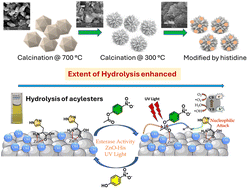
Zinc oxide (ZnO) nanocatalysts were synthesized via a co-precipitation route and thermally modulated at different calcination temperatures (300 °C and 700 °C) to elucidate the influence of thermal treatment on their physicochemical and catalytic properties. Comprehensive structural and surface analyses revealed that ZnO-300 possesses smaller crystallite size, higher surface area, and a three-dimensional nanoflake morphology enriched with abundant surface hydroxyl groups. In contrast, ZnO-700 forms a compact three-dimensional polyhedral structure with significantly reduced surface hydroxylation. The catalytic performance was systematically evaluated through the aqueous hydrolysis (pH 7.4) of a model acyl ester, p-nitrophenyl acetate (PNPA), and its long-chain analogue, p-nitrophenyl dodecanoate (PNPD). ZnO-300 exhibited superior catalytic efficiency, attributed to its enhanced surface area and higher density of surface hydroxyl groups. Furthermore, surface functionalization of ZnO-300 with histidine introduced Lewis acid–Brønsted base dual functionality and improved hydrophilicity, leading to enhanced hydrolytic activity. Under UV illumination, both ZnO-300 and histidine-modified ZnO (ZnO-His) showed pronounced photoactivation, with ZnO-His displaying the highest reactivity due to improved charge separation and radical-mediated pathways involving hydroxyl (˙OH) and superoxide (˙O2−) species. Kinetic investigations revealed pseudo-first-order and Michaelis–Menten-type behaviour, while recyclability studies confirmed the structural integrity and reusability of the catalysts. Owing to its superior performance, ZnO-His was further employed for the UV-assisted hydrolysis of bioactive ester derivatives, such as ethyl gallate. The formation of the corresponding hydrolysis products was independently confirmed by ESI-MS analysis.
 Please wait while we load your content...


