


 PLATFORM UPDATE:


A high power, low temperature molten sodium battery
 a
Amanda S.
Peretti,
a
Stephen J.
Percival,
a
Philip S.
Mantos,
a
Erik D.
Spoerke
a
and
Leo J.
Small
*a
a
Amanda S.
Peretti,
a
Stephen J.
Percival,
a
Philip S.
Mantos,
a
Erik D.
Spoerke
a
and
Leo J.
Small
*a
Abstract
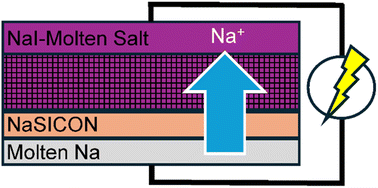
Low temperature molten sodium batteries promise low-cost, grid-scale energy storage using earth-abundant materials. To be economically viable, they must demonstrate high current (power) at relevant discharge times. Here a low temperature (135 °C) molten sodium battery with a NaI–AlCl3 molten salt catholyte and NaSICON separator is explored, minimizing cell ohmic resistances and avoiding precipitation reactions in the molten salt catholyte. Operating currents were increased by as much as 100× compared to the energy-dense baseline design (197 Wh kg−1 and 248 mAh cm−2). Cells were cycled 100 times at 50 mA cm−2 (150 mW cm−2), averaging 99.8% coulombic efficiency and 79.7% energy efficiency for 30% of the theoretical capacity. Charging currents up to 250 mA cm−2 (1070 mW cm−2) are demonstrated for 10% of the theoretical capacity. Toward extending the accessible capacity in these high current systems, the volume ratio of catholyte molten salt to a graphite felt current collector was varied, altering (1) the local current density in the graphite felt and (2) the discharge time at a fixed current density. Optimizing the catholyte : felt ratio dramatically increased capacity utilization to 60% (102 mAh cm−2) at 50 mA cm−2 (150 mW cm−2) charge and 10 mA cm−2 discharge. This catholyte : felt ratio of 1.4 significantly decreased the cell impedance, minimizing electrode blocking effects seen previously in NaI–AlCl3 catholytes. Together, these high areal loadings and impressive power outputs demonstrate how low temperature molten sodium batteries can compete with commercialized sodium systems operating at more than twice the temperature.
 Please wait while we load your content...


