


 PLATFORM UPDATE:


Constructing a covalently Si–O–C bonded diatomite-derived SiO2@C anode for high-capacity lithium-ion batteries
 *b
*b
Abstract
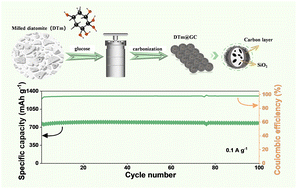
Silica-based materials, serving as one type of prospective electrode for advanced high-energy density LIBs (lithium-ion batteries), are encountering critical obstacles in commercialization, including inherently poor conductivity, volume expansion and particle pulverization. Herein, a ball-milled diatomite combined with glucose-derived carbon (DTm@GC) has been synthesized as an anode for LIBs by constructing a dense carbon network on the diatomite-derived SiO2 through Si–O–C covalent bonding. The strong and dense Si–O–C covalent bond between the carbon network and diatomite accelerates migration of Li+ and alleviates volume variation during lithiation/de-lithiation. The results show that the DTm@GC anode delivers a superior discharge specific capacity of 781 mA h g−1 after 100 cycles at 0.1 A g−1, along with approximately 100% capacity retention. Furthermore, the synthesized anode can maintain a stable specific capacity of 613.79 mA h g−1 after 200 cycles at 0.5 A g−1, and 456.68 mA h g−1 over 1000 consecutive cycles at 1 A g−1. The outstanding electrochemical performance of DTm@GC with a strong covalent Si–O–C bond provides a valuable avenue for fabricating low-cost, high-performance SiO2-based anodes for high-capacity LIBs.
 Please wait while we load your content...


