


 PLATFORM UPDATE:


Large scale valorization of steel slag combined with membrane-based direct air capture for carbon mineralization: a techno-economic evaluation
 *bc
and
*bc
and
Abstract
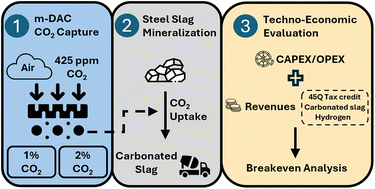
The removal of carbon dioxide (CO2) from the atmosphere and from hard-to-abate industrial processes such as steel production remains a significant challenge for meeting climate goals. Progressive studies on membrane-based direct air capture (m-DAC) have emerged to propose this technology as a promising option for addressing legacy emissions. Previous studies discussed computational techniques that can search for favorable operational regions and suitable membrane material properties that give satisfactory CO2 capture performance and system energy efficiency. The combination of operability studies with membrane modeling and simulation represented a novel pathway to investigate fundamental material/process parameters tied to large-scale metrics. In this work, we explore a two-fold approach aiming to intensify CO2 capture and utilization: (i) capturing CO2 from ambient air (425 ppm) using m-DAC and concentrating it (25–50) times, and (ii) treating steel slags through CO2 mineralization for the synthesis of cementitious materials. Each process was initially investigated separately, and their integration was then analyzed based on the overall technoeconomic viability and CO2 removal efficiency per ton captured. The m-DAC process provides a low-purity (1–2%) CO2 stream suitable for combination with mineralization. Slag-water CO2 mineralization using 1% and 2% CO2 achieves conversion rates of 55.4% and 43.3%, respectively, producing carbonated slag. Additionally, the slag can be reacted with steam to yield 16.99 std. ml H2 per gram, utilizing waste heat from steelmaking. This dual process enables revenue generation from both H2 production and carbonated slag, which can be sold as a supplementary cementitious material.
 Please wait while we load your content...


