


 PLATFORM UPDATE:


Projections of when each of 150 countries may eliminate air pollution and carbon emissions from all energy

Abstract
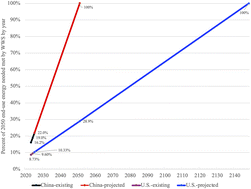
Whether the world addresses global warming, air pollution, and energy insecurity in a timely manner depends largely on country transition rates to clean, renewable energy. Yet, no study has examined transition rates by country, especially using recent data. This study estimates when 150 countries can potentially transition to 100% clean, renewable energy across all energy sectors, upon near-electrification of each sector, if the countries add such energy at their most recent rates. Such a transition eliminates air pollution and carbon emissions from energy. Results suggest the world's largest energy consumer and emitter, China, is currently on track to transition fully, thus eliminate 100% of its energy-related health- and climate-damaging pollution, by 2051. China's projected 2025 renewable output increase is 20 times France's fastest (in 1981) nuclear output increase. Further, in 2025, China may already produce ∼54% of the clean, renewable energy that the United States will need for supplying 100% of its all-sector demand with clean, renewable energy in 2050. Seven countries could potentially reach 100% renewables faster than China. India and the United States may reach 100% only beyond 2130. Thus, policies focusing on clean, renewable energy alone can effectively speed a transition.
- This article is part of the themed collection: HOT articles from RSC Sustainability
 Please wait while we load your content...


