


 PLATFORM UPDATE:


Supercritical CO2-foamed polystyrene composites containing wood-derived biochar for sustainable thermal insulation
Abstract
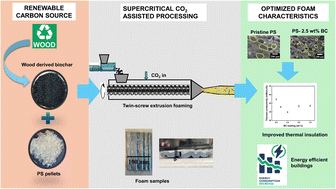
Building insulation materials with low environmental impact are critical for reducing energy use and greenhouse gas emissions. In this study, sustainable polystyrene (PS) composite foams were developed by incorporating wood-derived biochar (0–7.5 wt%) using supercritical CO2 (sc-CO2) extrusion. The foam containing 2.5 wt% biochar (BC) exhibited the smallest average cell size (∼86 µm), highest cell density (∼3.3 × 10⁸ cells per cm3), and narrowest cell size distribution. Correspondingly, its thermal conductivity decreased from 36 to 32 mW m−1 K−1 (≈11% reduction), while the specific compressive strength reached 3.9 MPa g−1 cm3, approximately 100% higher than pristine PS foam. Transmission electron microscopy confirmed uniform BC dispersion and localization along cell walls, indicating its role as an effective nucleating agent. Micro-computed tomography (micro-CT) further verified increased BC content and distribution in the 2.5 wt% foam, supporting the observed improvements in cellular structure and performance. These results demonstrate that BC effectively enhances the foaming behavior, thermal insulation and mechanical performance of the composite. Furthermore, comparative embodied carbon and thermal resistance analyses indicate that BC addition improves the overall environmental sustainability and promotes circular material use in PS–BC composite foams, offering a scalable pathway for developing next-generation sustainable insulation materials.
 Please wait while we load your content...


