


 PLATFORM UPDATE:


AI-based development of a portfolio of indicators for assessing environmental, social and economic impacts and technological functionality of chemicals and materials

Abstract
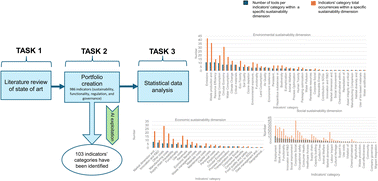
The European Commission's (EC) Joint Research Center (JRC) Safe and Sustainable by Design (SSbD) framework (JRC-SSbD framework) has highlighted the importance of assessing safety and sustainability as early as possible in the innovation process and in a pragmatic way. This has created the need to operationalise the framework with cost-effective methods and tools for simplified sustainability assessment. The development of such approaches is not a straightforward task: it requires integration of diverse technical indicators for life cycle assessment of environmental, social and economic impacts. Despite intensive ongoing work in EU research and innovation projects, a comprehensive inventory of such indicators is not yet available. To address this gap, our study employed an AI (Artificial Intelligence)-driven knowledge extraction process to compile an extensive portfolio of 986 environmental, social, economic and functionality indicators grouped in 103 categories relevant for both chemicals and materials. The AI output required substantial human expert intervention, as the categorisation process proved inaccurate across several indicators. In addition, an approach for statistical data analysis was developed and applied to prioritise which indicators should be considered first in simplified sustainability assessments. We expect that this work will have important contribution towards the operationalisation of the JRC-SSbD framework and can help companies to anticipate which information they need to collect to assess the sustainability and functionality of their products, already in the early stages of product development. This can reduce the overall Research and Development and Innovation (R&D&I) costs of the European industries and increase their competitiveness in the transition to a greener economy.
 Please wait while we load your content...


