Semi-crystalline and recyclable pressure sensitive adhesives from non-edible rapeseed oil-based hyperbranched polyester vitrimers

Abstract

Hyperbranched polymers exhibit distinctive properties attributed to their highly branched architecture and the abundant functional groups they carry. In this study, we synthesized innovative hyperbranched polyesters from vegetable oil derivatives without utilizing solvents. The reaction conditions were optimized and these polymers were comprehensively characterized based on size distribution, degree of branching and molecular structure. These hyperbranched polymers manifest as sticky viscous liquids with semi-crystalline behavior, featuring glass transition temperatures (Tg) and melting temperatures (Tm) as low as 18 °C. Subsequently, the latter were utilized as precursors for the design of unique thermosets with potential self-healing and recyclable pressure-sensitive adhesive properties.
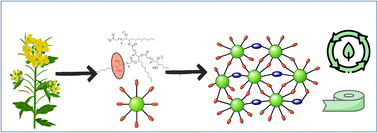
Graphical abstract: Semi-crystalline and recyclable pressure sensitive adhesives from non-edible rapeseed oil-based hyperbranched polyester vitrimers

Supplementary files

Transparent peer review

To support increased transparency, we offer authors the option to publish the peer review history alongside their article.

View this article’s peer review history

Article information

Article type
Paper
Submitted
15 Nov 2025
Accepted
18 Nov 2025
First published
28 Nov 2025
This article is Open Access
Creative Commons BY-NC license

RSC Sustainability, 2026, Advance Article

Semi-crystalline and recyclable pressure sensitive adhesives from non-edible rapeseed oil-based hyperbranched polyester vitrimers

V. Ayzac, B. Bizet, M. Reulier, G. Chollet, C. Le Coz, E. Grau and H. Cramail, RSC Sustainability, 2026, Advance Article , DOI: 10.1039/D5SU00868A

This article is licensed under a Creative Commons Attribution-NonCommercial 3.0 Unported Licence. You can use material from this article in other publications, without requesting further permission from the RSC, provided that the correct acknowledgement is given and it is not used for commercial purposes.

To request permission to reproduce material from this article in a commercial publication, please go to the Copyright Clearance Center request page.

If you are an author contributing to an RSC publication, you do not need to request permission provided correct acknowledgement is given.

If you are the author of this article, you do not need to request permission to reproduce figures and diagrams provided correct acknowledgement is given. If you want to reproduce the whole article in a third-party commercial publication (excluding your thesis/dissertation for which permission is not required) please go to the Copyright Clearance Center request page.

Read more about how to correctly acknowledge RSC content.

Social activity

Spotlight

Advertisements