


 PLATFORM UPDATE:


An integrated approach of green chemistry and analytical quality-by-design for simultaneous estimation of drugs in a fixed-dose combination by a stability-indicating RP-HPLC method

Abstract
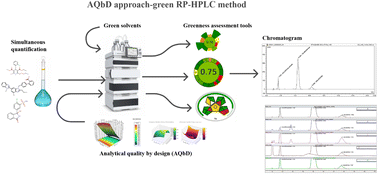
The RP-HPLC analytical method has been developed and validated for the simultaneous quantification of chlorthalidone (CHL), amlodipine (AML) and telmisartan (TEL) in a combination drug formulation. An analytical quality-by-design (AQbD) framework was applied using three critical method variables—pump flow rate, oven temperature and pH—to systematically evaluate their influence on chromatographic performance. The mobile phase consists of a water and ethanol mixture and is free from any toxic solvents. Response surface and contour plots enabled robust optimization with final conditions of ethanol–water (35 : 65 v/v) containing 0.1% triethylamine and adjusted to pH 2.3 with orthophosphoric acid. Chromatographic separation was achieved on a Sunniest C18 column (150 mm, 4.6 mm, 5 µm) under isocratic conditions. The method operated at a column flow rate of 1.6 mL min−1 with a photodiode array detector. The method was performed using an AQbD-driven response surface central composite design (CCD). The validated method exhibited excellent linearity within 50–150% of the target concentration with correlation coefficients (r) > 0.99 for all analytes. Accuracy studies showed overall mean recoveries of 101.4% for CHL, 100.1% for TEL and 100.4% for AML. Stress degradation under acidic, basic, oxidative, thermal, and photolytic conditions demonstrated that the method is stability-indicating with complete resolution of degraded products and confirmed spectral purity for all analytes. The ecological impact of the new analytical method was evaluated using a variety of greenness assessment techniques. Scores obtained were: AGREE (0.75), MoGAPI (79), BAGI (77.5), AGREE-Prep (0.78), RAPI (55.0), and AMGS-tool (80.96). These figures demonstrate a procedure that complies with green analytical principles with respect to solvent safety, low toxicity and decreased environmental impact. The moderate RAPI score highlighted opportunities for improvement related to energy consumption and instrument efficiency. The proposed RP-HPLC method is precise, accurate, and stability-indicating, and also environmentally responsible, offering a robust and sustainable analytical approach for the simultaneous estimation of drugs in fixed-dose formulations.
- This article is part of the themed collection: HOT articles from RSC Sustainability
 Please wait while we load your content...


