


 PLATFORM UPDATE:


Kinetic analysis and optimization of sonoreactor process for production of humic and fulvic acids from various coal feedstocks

Abstract
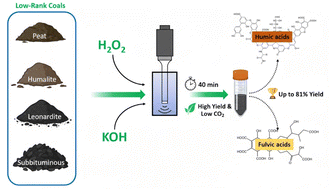
Developing high-yield, non-combustion applications for low-rank coals is critical for their sustainable utilization. This study demonstrates a rapid ultrasonic process, using H2O2 in an alkaline medium, to efficiently convert four distinct low-rank coals (humalite, leonardite, peat, and subbituminous) into valuable humic and fulvic acids. The process achieved high conversions for all feedstocks, with the more oxidized coals, leonardite and humalite, showing the highest conversions (91% and 88%, respectively) and humic acid yields (81% for both). A double triangular lump kinetic model revealed that ultrasonication preferentially favors the reaction pathway toward humic acids over fulvic acids and CO2, with lower apparent activation energies for humic acid formation across all feedstocks. This was most pronounced for humalite and leonardite (51 and 58 kJ mol−1). Spectroscopic and titrimetric analyses confirmed the successful incorporation of oxygen-containing functional groups (COOH and OH) into the coal structure, driven by the attack of ˙OH radicals generated during sonication. Overall, this work establishes an efficient and selective pathway for producing humic acids from low-rank coals, presenting a scalable technology for converting these resources into high-value soil amendments.
 Please wait while we load your content...


