


 PLATFORM UPDATE:


Production of magnesium ferrite for use as phosphate adsorbents in water

Abstract
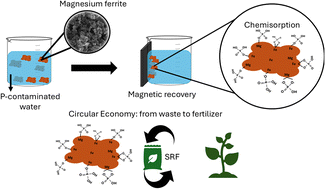
In this study, magnesium ferrite was synthesised at different calcination temperatures (300, 700, and 900 °C), and its phosphate adsorption potential was evaluated. TG, XRD, Mössbauer spectroscopy, and VSM data indicate the formation of the magnesium ferrite phase, MgFe2O4, in the inverted spinel and mixed spinel structures at different calcination temperatures, exhibiting superparamagnetic characteristics. Adsorption studies indicate that the presence of MgFe2O4 favours phosphate adsorption, and the magnetic properties facilitate the recovery of the adsorbents by approaching magnets. The phosphate adsorption isotherm curves obtained for the materials MgFe700 and MgFe900 indicate that adsorption occurs at specific sites, attributed to Mg and Fe on the surface of the material, with a better fit for the Temkin and Langmuir isothermal models, respectively. The kinetic tests indicate two stages of adsorption, the first with fast adsorption and the second with a slower process. The data exhibit a better fit to the Elovich kinetic model, indicating that chemisorption occurs on the material's surface with specific adsorption sites. Phosphate adsorption tests show that the materials can be applied in a wide pH range (3 to 10) and in the presence of anions such as Cl−, NO3−, and HCO3−, commonly present in natural and wastewater, with adsorption capacities between 16 and 30 mg g−1 for MgFe700 and between 19 and 28 mg g−1 for MgFe900. The desorption tests of the materials revealed a strong interaction between the adsorbent and adsorbate, hindering the release of phosphate adhered to the material's surface and, consequently, leading to a low reuse rate.
 Please wait while we load your content...


