


 PLATFORM UPDATE:


Life-cycle analysis of microalgae-based polyurethane foams
 a
Matthew R.
Wiatrowski,
b
Pahola Thathiana
Benavides,
*a
Jingyi
Zhang,
a
Ryan
Davis
b
and
Troy R.
Hawkins
a
a
Matthew R.
Wiatrowski,
b
Pahola Thathiana
Benavides,
*a
Jingyi
Zhang,
a
Ryan
Davis
b
and
Troy R.
Hawkins
a
Abstract
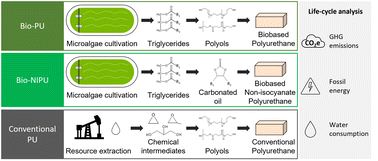
Polyurethane plastics are essential in many consumer and commercial products such as insulation, furniture, automotive interiors, and clothing. Pathways for producing polyurethane from microalgae offer an opportunity to reduce greenhouse gas emissions and other environmental impacts and can incorporate processes that avoid the use of toxic isocyanates typically used in conventional polyurethane production processes. In this study, the greenhouse gas emissions, fossil energy, and water consumption of biobased polyurethane and biobased non-isocyanate polyurethane were evaluated via life-cycle analysis using the R&D Greenhouse Gases, Regulated Emissions, and Energy Use in Technologies model. Microalgae-based polyurethane foam was found to achieve greenhouse gas emission reductions of up to 79% compared with conventional polyurethane foam production. The greenhouse gas reductions for the non-isocyanate microalgae polyurethane pathway are slightly lower at 58% compared with conventional polyurethane foam. However, it offers additional benefits by reducing toxicity potential compared to the isocyanate polyurethane pathway. The analysis also included a biorefinery-level analysis to evaluate the impact of incorporating polyurethane production into fuel-processing microalgae biorefineries. The sensitivity analyses conducted in this study reveal that improved algae cultivation strategies can lead to decreases of up to 127% and 80% in GHG emissions from the baseline process of Bio-PU and Bio-NIPU, respectively. Likewise, implementation of renewable electricity can result in up to 128% and 74% lower GHG emissions compared to the baseline production of Bio-PU and Bio-NIPU, respectively. Finally, the analysis evaluated different coproduct handling methods including displacement and allocation (based on mass, energy, and market-value). The results suggest that it is important to consider both the displacement and allocation methods as these led to significant differences in the environmental impacts.
- This article is part of the themed collection: Celebrating International Women’s Day 2026: Women in RSC Sustainability
 Please wait while we load your content...


