


 PLATFORM UPDATE:


Emerging and persistent challenges of transitioning to solid-state electrolytes for hydrogen production from water splitting

Abstract
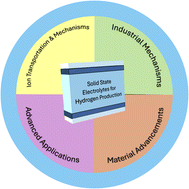
One of the biggest challenges we are faced with in the 21st century is closing the anthropogenic carbon cycle and shifting away from a fossil-fuel dependent society. Hydrogen, one of the alternative fuels, is seeing unprecedented investment and deployment. However, obtaining cost competitive green hydrogen at industrial scale remains a challenge. Optimizing water electrolysis is, in this context, an increasingly important research area. Currently, a major portion of electrolytic green hydrogen is generated by aqueous alkaline electrolytes, but their limitation to relatively low current densities, low operating pressures and the corrosion of metallic components over prolonged use, as well as other fluctuating parameters, raise the price of hydrogen to an uncompetitive level. Water electrolysers using solid-state electrolytes (SSEs) have been gaining more interest in recent years in an attempt to accelerate cost competitive electrolytic green hydrogen production at scale. Despite many advantages, SSE-based electrolysers are still facing limitations such as sub-optimal ionic conductivity, inefficient electrode/electrolyte interface and short operating lifetimes. In this review, we aim to offer an overview of both the current state-of-the-art SSE technologies, as well as the most recent material designs addressing these limitations. We outline advancements made in the field of electrolysis technologies which we believe could serve as inspiration for the further improvement of SSEs in water electrolysis. Lastly, we summarize the remaining open questions and emerging trends, hoping that further research will use the improvements made in various fields to improve the efficiency of SSEs in water electrolysis.
 Please wait while we load your content...


