


 PLATFORM UPDATE:


Carbon dots in agriculture: fundamentals, applications and perspectives
 *a
and
Hongwei
Lei
*a
*a
and
Hongwei
Lei
*a
Abstract
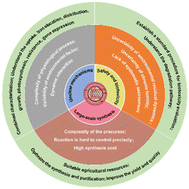
Carbon dots (CDs) have garnered significant attention since their discovery in 2004. Their excellent optoelectronic properties, superior biocompatibility, and ecological friendliness make them very promising for sustainable agricultural applications. In this review, the synthesis strategies of CDs are first summarized and the photoluminescence mechanisms, with a specific focus on linking these fundamentals to their functions in agricultural production, are elucidated. Then the diverse applications of CDs in agriculture are detailed, specifically highlighting their roles as photosynthetic efficiency enhancers, light-conversion films and LEDs for controlled-environment agriculture, and versatile nanosensors for detecting critical agricultural metrics. Finally, the current challenges and prospects of CDs are discussed to guide their further innovative exploration in agriculture.
- This article is part of the themed collection: RSC Sustainability Recent Review Articles
 Please wait while we load your content...


