


 PLATFORM UPDATE:


Recovery of terephthalic acid from solar PV backsheets using waste solvent from distilled spirits production

Abstract
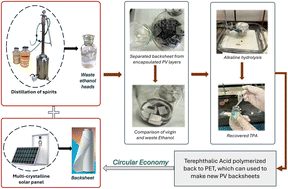
Current research on solar photovoltaic (PV) recycling mainly focuses on recovering valuable metals and glass, often neglecting the polymeric components, particularly the backsheets, which are typically landfilled or thermally decomposed. This study explores an innovative approach to upcycle PV backsheets into value-added products, specifically terephthalic acid (TPA), using waste ethanol solvent from the distilled spirits industry. Experimental results show that increasing both exposure time and ethanol concentration significantly enhances backsheet delamination efficiency. Using waste ethanol, a maximum delamination efficiency of 80% was achieved at room temperature after 24 hours. In decomposition trials, both sodium hydroxide (NaOH) and potassium hydroxide (KOH) demonstrated comparable efficiencies (96.6–97.5%) over 8 and 24 hour reactions. With virgin ethanol, NaOH yielded 94–97.5% TPA recovery. Notably, using waste ethanol achieved a TPA recovery efficiency of 96.8%, underscoring the process's economic viability and sustainability. Analytical characterization of TPA recovered after 8 hours showed consistent spectral patterns across both alkalis and solvents, indicating a similar chemical environment and functional groups. The recovered TPA can be repolymerized into high-purity PET, suitable for manufacturing new PV backsheets. This work advances polymer-recycling by demonstrating that an industrial waste solvent (distilled-spirits ‘heads’) can replace virgin ethanol without loss in delamination performance or TPA yield. While PV backsheet PET is a modest share of global PET, using waste ethanol to upcycle this currently under-recycled stream demonstrates a transferable solvent-reuse pathway that can extend to higher-volume PET sources.
- This article is part of the themed collection: Celebrating International Women’s Day 2026: Women in RSC Sustainability
 Please wait while we load your content...


