


 PLATFORM UPDATE:


Polyaniline-based ternary composites for the photocatalytic degradation of organic pollutants in wastewater: multifunctional properties, synthetic routes, and mechanistic insights

Abstract
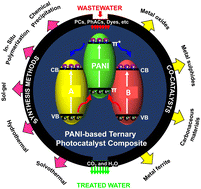
The widespread applications of pharmaceuticals, pesticides, dyes, and industrial chemicals have caused extensive contamination of water resources globally. Conventional wastewater treatment processes have been inefficient for the elimination of these contaminants, resulting in their sustained accumulation. Among advanced oxidation processes (AOPs), photocatalysis has garnered notable attention as an effective method for the degradation of organic pollutants owing to its ability to achieve complete mineralization. However, the degradation performance of conventional single and binary composites remains constricted by rapid electron–hole recombination, limited light absorption ability, and material instability. Recent research has been focused on the development of ternary composite systems incorporating conducting polymers, which synergistically utilize the unique advantages of organic and inorganic components to enhance the photocatalytic efficiency. Particularly, polyaniline (PANI) has emerged as a promising conducting polymer owing to its simple synthesis, tunability, electrical conductivity, environmental stability, and efficient electron transport properties. This review provides a comprehensive analysis of the synthesis and properties of PANI and its application in ternary composites. The PANI-based ternary composites have been further evaluated for their synthetic routes, photocatalytic degradation mechanism, applicability, stability, and reusability, confirming their efficiency as photocatalysts. Additionally, their key challenges and limitations are critically evaluated, and future research directions are proposed to advance PANI-based ternary composites for sustainable wastewater treatment.
 Please wait while we load your content...


