


 PLATFORM UPDATE:


Red sanders bark extracts as effective bio-protective agents against fungal and termite degradation of plantation timbers
 *a
*a
Abstract
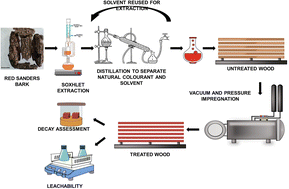
Red sanders (Pterocarpus santalinus), an endemic species of Southern India, is highly valued for its heartwood, yet its bark is frequently discarded as waste. The sustainable utilization of underutilized bark offers a promising route to develop bio-based wood preservatives. This study investigates the bio-protective efficacy of Pterocarpus santalinus bark extracts against fungal and termite degradation in plantation timbers. Gravimetric analysis revealed markedly higher yields for aqueous extracts (26.22%) compared to acetone (2.59%) and methanol (1.05%) extracts. Three wood species: rubberwood (Hevea brasiliensis: HB), mango wood (Mangifera indica: MI), and melia wood (Melia dubia: MD) were pressure-impregnated with 3% and 8% extract concentrations for 1 h and 2 h. Retention values in different wood species ranged from 0.94 to 8.81 kg m−3, while weight percent gain reached 17.88%, especially in lower-density MD. Acetone extracts conferred the strongest antifungal protection, reducing brown-rot (Oligoporus placentus) mass loss from 46% (control HB) to 11% (HB at 8%), and white-rot (Trametes hirsuta) mass loss from 38% to 11%. A similar phenomenon was seen in MI and MD wood. Termite damage ratings declined from 5.0 (complete failure) in untreated HB and MI to 1.7 and 2.8 post-treatment, and to 0.2 in MD. Leaching resistance improved with higher concentrations and longer impregnation times, while FTIR spectra confirmed the preservation of lignin and hemicellulose associated peaks after fungal tests. SEM confirmed that the extracts form protective barriers into the wood, inhibiting microbial degradation and termite infestation.
 Please wait while we load your content...


