


 PLATFORM UPDATE:


Application of MXenes for emerging contaminant removal and water purification: a revolutionary approach
 *a
Dominika
Bury,
d
*a
Dominika
Bury,
d
Abstract
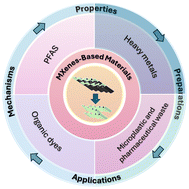
Emerging water contaminants, including dyes, heavy metals, pharmaceuticals, per- and poly-fluoroalkyl substances (PFAS), and micro- and nano-plastics, pose critical challenges for environmental sustainability and human health. Two-dimensional transition metal carbides and nitrides (termed as MXenes) have recently emerged as transformative materials for water purification owing to their high surface area, tunable chemistry, electrical conductivity, and photocatalytic activity. This review summarizes the latest advances in MXene-based adsorbents, membranes, and hybrid composites, elucidating the mechanistic underpinnings for adsorption, electrosorption, photocatalysis, and ion-exchange processes. Regeneration strategies, recyclability, and long-term stability are critically assessed, alongside the potential environmental and human health risks posed by MXenes and their degradation products. Key challenges in the scalable synthesis, structural stability, and membrane integration are highlighted, and strategies for mitigating toxicity and optimizing performance are proposed. The insights presented provide a roadmap for the design of next-generation, sustainable MXene-enabled water purification technologies.
 Please wait while we load your content...


