


 PLATFORM UPDATE:


Dynamic water film assisted laser micromachining of micro-array structured surfaces for inducing hydrophobicity: analysis model and experimental study
 *ab
Yanling
Tian
b
*ab
Yanling
Tian
b
Abstract
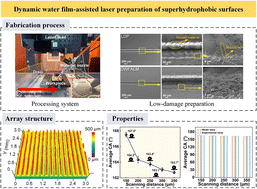
With the advantages of non-contact processing and high precision, laser micromachining technology has shown great potential for applications in functional surface fabrication. However, thermal damage issues inevitably arise during the machining process. This study takes Ti6Al4V titanium alloy as the research object and compares the processing effects of laser direct processing (LDP) and dynamic water film assisted laser machining (DWFALM). The effects of varying laser processing spacing on surface morphology and wetting properties were investigated. The results indicate that, compared with the conventional LDP technique, DWFALM reduces the extent of the heat-affected zone (HAZ), suppresses molten layer formation, and mitigates microcrack defects. By adjusting the scanning spacing, a superhydrophobic surface with a contact angle (CA) of up to 167.6° and a rolling angle (RA) as low as 2.2° was fabricated. In addition, the CA prediction model established in this study was consistent with the experimental measurements, with an average error below 2%. This research achievement not only provides theoretical guidance for the controllable preparation of superhydrophobic surfaces but also offers new approaches for achieving efficient and low damage surface processing. The micro-array-structured superhydrophobic Ti6Al4V surface fabricated by DWFALM shows potential for applications in anti-fouling, anti-icing, seawater desalination, and related fields.
 Please wait while we load your content...


