


 PLATFORM UPDATE:


Equilibrium fluctuations of a quasi-spherical vesicle: role of the membrane dissipation
 *a
and
*a
and
Abstract
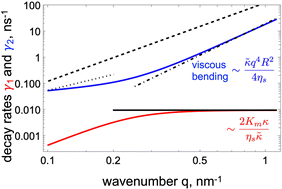
We theoretically investigate the thermally-driven curvature and lipid density fluctuations of a quasi-spherical vesicle, accounting for the dissipation due to monolayer viscosity and intermonolayer friction. The theory predicts that membrane curvature makes long-wavelength undulations sensitive to membrane viscosity and speeds up the relaxation of the lipid density fluctuations. Implications for the dynamic roughness and dynamic structure factor measurements of submicron liposomes on nano-second time scales are discussed. Specifically, a clear stretched-exponential relaxation regime may not exist, in contrast to the behavior of planar membranes for which an anomalous diffusion exponent of 2/3 has been predicted [A. G. Zilman and R. Granek, Undulations and dynamic structure factor of membranes, Phys. Rev. Lett., 1996, 77, 4788–4791].
- This article is part of the themed collections: Biomembranes and Biointerfaces and Soft Matter Open Access Spotlight 2026
 Please wait while we load your content...


