Influence of Rigid-Soft Domains on Proton Conduction and Microstructure in Block Copolymer Membranes

Abstract

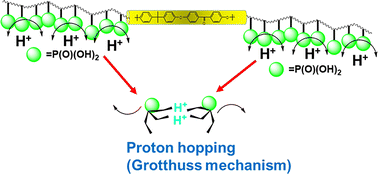
In ionic copolymers, chemically distinct domains can be combined to enhance proton transport and stability. In this work, we integrated a rigid engineering plastic, poly (ether ether ketone) (PEEK), with phosphonated polystyrene chains to fabricate membranes containing complementary rigid and soft molecular domains. The rigid PEEK chains provided thermal stability and mechanical integrity, while the flexible phosphonated polystyrene domains enabled proton conduction under anhydrous or low-humidity conditions. The resulting membranes exhibited a proton conductivity approaching 10⁻³ S/cm at 50% relative humidity and 1 bar vapor pressure. Structural analysis revealed planar, porous surfaces and supported the role of proton hopping as the dominant conduction mechanism, with activation energies in the range of 0.08-0.50 eV. These findings highlight how rigid-soft molecular design can balance stability and conductivity, making such membranes promising candidates for use as separators in hydrogen or methanol fuel cells.Highlights Proton conducting membranes were developed using tri-block copolymers with rigid and soft polymeric domains  A clear correlation was established between proton conduction and nanostructure originated from 'rigid' and 'soft' polymer chains  Rigid PEEK chains enhance thermal stability and contribute to formation of planar membrane  Rigid domains in copolymers disrupt the ionic channels affecting membrane conductivity  In ionic soft domain, the intrinsic proton conductivity was dominated by the hopping process

Supplementary files

Transparent peer review

To support increased transparency, we offer authors the option to publish the peer review history alongside their article.

View this article’s peer review history

Article information

Article type
Paper
Submitted
12 Feb 2026
Accepted
30 Apr 2026
First published
04 May 2026

Soft Matter, 2026, Accepted Manuscript

Influence of Rigid-Soft Domains on Proton Conduction and Microstructure in Block Copolymer Membranes

A. Kumar and D. W. Chang, Soft Matter, 2026, Accepted Manuscript , DOI: 10.1039/D6SM00130K

To request permission to reproduce material from this article, please go to the Copyright Clearance Center request page.

If you are an author contributing to an RSC publication, you do not need to request permission provided correct acknowledgement is given.

If you are the author of this article, you do not need to request permission to reproduce figures and diagrams provided correct acknowledgement is given. If you want to reproduce the whole article in a third-party publication (excluding your thesis/dissertation for which permission is not required) please go to the Copyright Clearance Center request page.

Read more about how to correctly acknowledge RSC content.

Social activity

Spotlight

Advertisements