


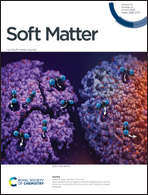
Ionic-content-driven restructuring of spirobisindane ionene networks: implications for mechanics, self-healing, and gas transport
 a
Alain Tundidor
Camba,
b
Pravin S.
Shinde,
b
Jong
Keum,
cd
Jason E.
Bara
*b
and
Jihong A.
Ma
*aef
a
Alain Tundidor
Camba,
b
Pravin S.
Shinde,
b
Jong
Keum,
cd
Jason E.
Bara
*b
and
Jihong A.
Ma
*aef
Abstract
Polymers of intrinsic microporosity (PIMs) offer exceptional gas permeability but remain brittle and susceptible to physical aging, limiting their durability in separation applications. Here, we introduce a reconfigurable microporous polymer network that uniquely integrates permanent PIM microporosity with autonomous, intrinsic self-healing driven by imidazolium-based ionic motifs. Spirobisindane units generate the intrinsic free-volume architecture, while an imidazolium-containing polyamide ionene supplies dynamic ionic and hydrogen-bonding interactions that reorganize under mild activation. Incorporation of imidazolium-based ionic liquids further tunes cohesion, mobility, and densification, enabling the network to relax, re-associate, and retain microporosity without structural collapse. Through a comprehensive multiscale approach combining spectroscopy, scattering, thermal and mechanical characterization with all-atom molecular dynamics and density functional theory calculations, we elucidate how ionic content, as a single control parameter that reshapes free-volume distributions, modulates local coordination environments, and governs relaxation and healing kinetics. At intermediate ionic loadings, the networks achieve rapid, repeatable self-healing while maintaining CO2 selectivity, demonstrating an optimal balance between segmental mobility and structural integrity. By establishing how hierarchical ionic interactions couple structure, dynamics, and transport in microporous ionene networks, this work provides generalizable design rules for adaptive soft-matter systems that require simultaneous mechanical resilience, reconfigurability, and selective gas transport.

- This article is part of the themed collections: Soft Matter Open Access Spotlight 2026 and Soft Matter Emerging Investigators Series
 Please wait while we load your content...


