


 PLATFORM UPDATE:


Self-assembly of quasicrystals under cyclic shear

Abstract
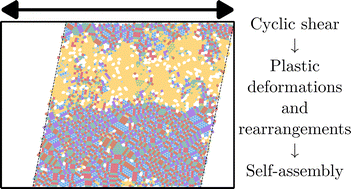
We investigate the self-assembly of two-dimensional dodecagonal quasicrystals driven by cyclic shear, effectively replacing thermal fluctuations with plastic rearrangements. Using particles interacting via a smoothed square-shoulder potential, we demonstrate that cyclic shearing drives initially random configurations into ordered quasicrystalline states. The resulting non-equilibrium phase diagram qualitatively mirrors that of thermal equilibrium, exhibiting square, quasicrystalline, and hexagonal phases, as well as phase coexistence. Remarkably, the shear-stabilised quasicrystal appears even where the zero-temperature equilibrium ground state favours square–hexagonal coexistence, suggesting that mechanical driving can stabilise quasicrystalline order in a way analogous to entropic effects in thermal systems. The structural quality of the self-assembled state is maximised near the yielding transition, even though the dynamics are slowest there. Yet, the system still quickly forms monodomain quasicrystals without any complex annealing protocols, unlike at equilibrium, where thermal annealing would be required. Finite-size scaling analysis reveals that global orientational order decays slowly with system size, indicative of quasi-long-range order comparable to equilibrium hexatic phases. Overall, our results establish cyclic shear as an efficient pathway for the self-assembly of complex structures.
- This article is part of the themed collection: Soft Matter Open Access Spotlight 2026
 Please wait while we load your content...


