


 PLATFORM UPDATE:


Wrinkles, rucks, and folds formed in a heavy sheet on a frictional surface
 *ab
and
Hirofumi
Wada
b
*ab
and
Hirofumi
Wada
b
Abstract
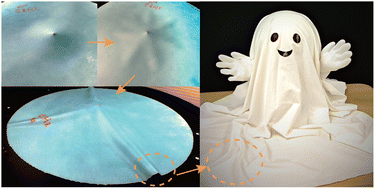
Soft elastic sheets resting on rigid surfaces develop wrinkles, rucks, and folds due to the combined influence of elasticity, gravity, and contact interactions. Despite their ubiquity, the principles governing their morphology and transitions remain unclear. We introduce a minimal experiment in which the center of a gravity-loaded sheet is gradually lifted from the supporting plane. This operation generates a clear sequence of shapes: an axisymmetric uplift, a finite number of wrinkles, system-spanning rucks produced by global buckling, and folded states that can arise from ruck collapse upon unloading at larger lifts. Combining experiments, finite-element simulations, and Föppl–von Kármán theory, we establish a unified physical picture of this morphology sequence. In the frictionless case, elasticity and gravity alone govern the response, leading to a universal wrinkling threshold: the wrinkle number is fixed and the onset displacement scales linearly with the sheet thickness. With interfacial friction, the wrinkled state is described by introducing an additional nondimensional parameter that compares frictional and elastic–gravitational forces. These results suggest a simple route to programmable sheet morphogenesis via friction and gravity.
 Please wait while we load your content...


