


 PLATFORM UPDATE:


Liquid crystalline derivatives exhibiting smectic phases with ferro- and antiferro-electric properties
 *a
Vladimíra
Novotná,
a
Terézia
Jurkovičová,
a
Věra
Hamplová,
a
Damian
Pociecha
b
and
Martin
Cigl
a
*a
Vladimíra
Novotná,
a
Terézia
Jurkovičová,
a
Věra
Hamplová,
a
Damian
Pociecha
b
and
Martin
Cigl
a
Abstract
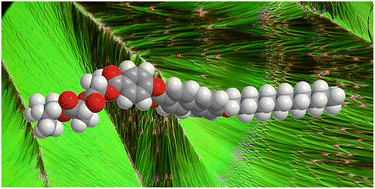
Chiral liquid crystalline molecules can self-assemble and generate ferroelectricity (FE) or antiferroelectricity (AF) in tilted lamellar smectic C phases. In previous studies, lactic acid has been repeatedly employed as an effective source of chirality. In this study, we synthesized several mesogens with the aim to establish the role of chiral chains and reveal their influence on the mesogenic and polar properties. For the first studied mesogen, we utilized a methylbutyl group in the chiral chain. The second mesogen differed from the first one in incorporated (S)-lactate group added to prolong the chain terminated with a methylbutyl. In the third homologue, two (S)-lactates and one methylbutyl group form the chiral chain. To establish their optical purity by high-performance liquid chromatography (HPLC), additional derivatives were prepared with a racemic methylbutyl chain. We compared all the homologues with respect to the effect of the chiral chain modification. Among them, the third derivative with two lactates in its chiral chain exhibited an AF smectic phase, which was stable and enantiotropic in a broad temperature range, including the room temperature, which could be attractive for various applications.
- This article is part of the themed collection: Soft Matter Open Access Spotlight 2026
 Please wait while we load your content...


