


 PLATFORM UPDATE:


Coupling of lipid phase behavior and protein oligomerization in a lattice model of raft membranes
 a
and
Oded
Farago
*a
a
and
Oded
Farago
*a
Abstract
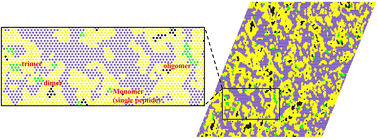
Membrane proteins often form dimers and higher-order oligomers whose stability and spatial organization depend sensitively on their lipid environment. To investigate the physical principles underlying this coupling, we employ a lattice Monte Carlo model of ternary lipid mixtures that exhibit liquid-disordered (Ld) and liquid-ordered (Lo) phase coexistence. In this framework, proteins are represented as small membrane inclusions with tunable nearest-neighbor interactions with both lipids and other proteins, allowing us to examine how protein–lipid affinity competes with protein–protein interactions and lipid–lipid demixing. We find that the balance of these interactions controls whether proteins remain dispersed, assemble into small oligomers, or form large stable clusters within Lo domains, and that increasing the protein concentration further promotes coarsening of the ordered phase. To incorporate ligand-regulated activation, we extend the model to a kinetic Monte Carlo scheme in which proteins stochastically switch between inactive and active states with distinct affinities. The inverse switching rate, relative to the time required for a protein to diffuse across the characteristic size of the Lo domains, governs the aggregation behavior. Rapid switching yields only transient small oligomers, slow switching reproduces the static limit with persistent large clusters, and intermediate rates produce broad cluster-size distributions. These results highlight the interplay between lipid phase organization, protein–lipid affinity, and activation dynamics in regulating membrane protein oligomerization, a coupling that is central to signal transduction and membrane organization in living cells.
 Please wait while we load your content...


