


 PLATFORM UPDATE:


Multiscale structural–rheological mapping of cancer spheroids during maturation

Abstract
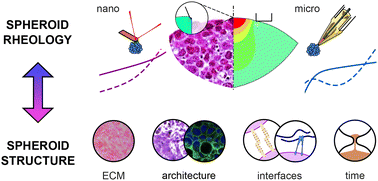
Recent studies highlight the central role of mechanical properties in understanding solid tumor biology, progression and therapeutic response. However, the mechanical characterization of 3D in vitro tumor models such as cancer spheroids remains incomplete. Current experimental and modeling frameworks often overlook their spatially varying and multiscale features, limiting a unified understanding of how spheroid structure governs mechanical response. Here, we combine atomic force microscopy and hydraulic force spectroscopy to perform multiscale microrheology of cancer spheroids, probing their mechanical evolution at both single-cell and multicellular levels over time. We identify a characteristic power-law behavior whose parameters capture contributions from intra- and inter-cellular mechanics, and we relate these parameters to structural organization and its temporal progression. This structure–rheology framework provides a mechanistic view of spheroid maturation and establishes a platform for future studies on tumor mechanobiology, therapy response, and engineered microenvironments.
 Please wait while we load your content...


