


 PLATFORM UPDATE:


Shape elasticity in colloidal bent-core liquid crystals

Abstract
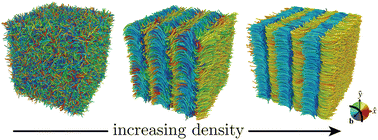
Curved particles have been shown to stabilize a range of states with unique order in dense suspensions of colloidal bent core liquid crystals. The shape of the colloidal rods encourages the formation of curved director fields. However, states of constant bend cannot uniformly fill either two or three dimensional Euclidean space and are therefore geometrically frustrated. As a result, curved rods are forced to couple their preference for bend with additional twist and splay deformations, giving rise to twist-bend and splay-bend states of nematic and smectic order. In this article, we study the effect of rod curvature on these diverse states of liquid crystalline order using molecular dynamics simulations of a bonded particle model of curved rods with tunable shape elasticity. Focusing on the case of intermediately curved rods, we find that curved rods go through a sequence of isotropic, nematic twist-bend and smectic splay-bend ordering as the density is increased from the dilute limit, in agreement with previous studies of rigid rods. As the rods become more elastic, the critical concentration separating these phases is shifted to higher density. Lastly, we find that flexibility weakens the first-order phase transition separating the isotropic and nematic twist-bend phases.
 Please wait while we load your content...


