


 PLATFORM UPDATE:


Using particle shape to control defects in colloidal crystals on spherical interfaces

Abstract
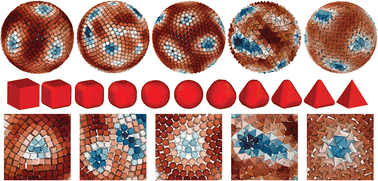
Spherical particles confined to a sphere surface cannot pack densely into a hexagonal lattice without defects. In this study, we use hard particle Monte Carlo simulations to determine the effects of continuously deformable shape anisotropy and underlying crystal lattice preference on inevitable defect structures and their distribution within colloidal assemblies of hard rounded polyhedra confined to a closed sphere surface. We demonstrate that cube particles form a simple square assembly, overcoming lattice/topology incompatibility, and maximize entropy by distributing eight three-fold defects evenly on the sphere. By varying particle shape smoothly from cubes to spheres we reveal how the distribution of defects changes from square antiprismatic to icosahedral symmetry. Congruent studies of rounded tetrahedra reveal additional varieties of characteristic defect patterns within three, four, and six-fold symmetric lattices. This work has promising implications for programmable defect generation to facilitate different vesicle buckling modes using colloidal particle emulsions.
- This article is part of the themed collection: Soft Matter Open Access Spotlight 2026
 Please wait while we load your content...


