


 PLATFORM UPDATE:


Thermotropic liquid crystal droplets stabilized by nanoparticles for the optical detection of phospholipid membranes: impact of membrane composition on LC ordering transitions
 a
Oscar H.
Piñeres-Quiñones,
a
Lawrence M.
Chen,
b
Sean P.
Palecek,
b
David M.
Lynn
*bc
and
Claribel
Acevedo-Vélez
*a
a
Oscar H.
Piñeres-Quiñones,
a
Lawrence M.
Chen,
b
Sean P.
Palecek,
b
David M.
Lynn
*bc
and
Claribel
Acevedo-Vélez
*a
Abstract
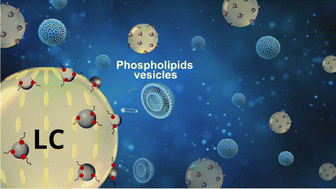
We report on the optical responses of nanoparticle-stabilized droplets of thermotropic liquid crystals (LCs) dispersed in water to phospholipid vesicles composed of single or mixed-lipid systems of dilauroyl phosphatidylcholine (DLPC), dioleoyl phosphocholine (DOPC), dioleoyl phosphoethanolamine (DOPE), and dioleoyl phosphoglycerol (DOPG). Our findings reveal these LC droplets to undergo bipolar-to-non-bipolar optical transitions upon exposure to vesicles in ways that depend upon phospholipid structure. Specifically, DLPC induced LC transitions at lower concentrations when compared to DOPC, while DOPE and DOPG did not trigger LC responses up to the highest lipid concentrations tested. Moreover, incorporating at least 30% DLPC into DOPC, DOPE, or DOPG vesicles significantly enhanced the sensitivity of stabilized LC droplets to these lipids. Notably, DLPC-containing DOPE and DOPG vesicles triggered LC transitions that were not observed with the corresponding single-component systems. Our findings provide fundamental insight into the behaviors of LC droplet-based systems that combine colloidal stability with sensitive optical responses to contact with model phospholipid vesicles. This work lays a foundation for exploring these nanoparticle-stabilized LC emulsions in contact with more complex lipid membrane mimics to support the design of responsive materials systems that can report the presence of lipid structures of interest in applied contexts, including vesicles, lipid nanoparticles, or mammalian or bacterial cells.
 Please wait while we load your content...


