


 PLATFORM UPDATE:


Rheological properties and shear-induced structures of ferroelectric nematic liquid crystals

Abstract
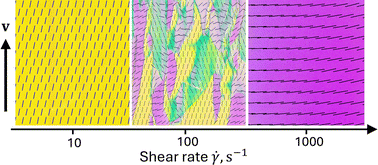
Recently discovered ferroelectric nematic (NF) liquid crystals are fluids with a polar orientational order. The electric polarization vector can be aligned by an electric field and by surface anchoring. Here, we explore how the polarization field and effective viscosity of the NF materials are affected by shear flows. We explore three NF materials, abbreviated RM734, DIO, and a room-temperature FNLC919, all of which exhibit a paraelectric nematic (N) and an NF phase. All materials show an increase in the effective viscosity upon cooling, with Arrhenius behavior in broad temperature ranges except near the phase transitions. In DIO and FNLC919, the antiferroelectric SmZA phase separating the N and NF phases shows a strong dependence of the effective viscosity on the shear rate: this viscosity is lower than the viscosity of the N and NF phases at high shear rates (![[small gamma, Greek, dot above]](https://www.rsc.org/images/entities/i_char_e0a2.gif) = 500 s−1) but is much higher when the shear rate is low, = 2.5 s−1. The behavior is associated with the layered structure of the SmZA phase. All mesophases in all three materials exhibit shear-thinning behavior at low shear rates (<100 s−1) and a nearly Newtonian behavior at higher shear rates. In terms of alignment, we observe three regimes in the N and NF phases: flow-alignment at low shear rates, < 102 s−1, a log-rolling regime with the director and polarization along the vorticity axis at > 103 s−1, and polydomain structures at intermediate rates. In the flow-aligning regime, the NF polarization does not tilt away from the shear direction, which is in sharp contrast to the flow-induced tilt of the N director. The effect is attributed to the avoidance of splay deformations and associated space charge in the flowing NF. The temperature and shear rate dependencies of the viscosity and the uncovered shear-induced structural effects of NF advance our understanding of these materials and potentially facilitate their applications.
= 500 s−1) but is much higher when the shear rate is low, = 2.5 s−1. The behavior is associated with the layered structure of the SmZA phase. All mesophases in all three materials exhibit shear-thinning behavior at low shear rates (<100 s−1) and a nearly Newtonian behavior at higher shear rates. In terms of alignment, we observe three regimes in the N and NF phases: flow-alignment at low shear rates, < 102 s−1, a log-rolling regime with the director and polarization along the vorticity axis at > 103 s−1, and polydomain structures at intermediate rates. In the flow-aligning regime, the NF polarization does not tilt away from the shear direction, which is in sharp contrast to the flow-induced tilt of the N director. The effect is attributed to the avoidance of splay deformations and associated space charge in the flowing NF. The temperature and shear rate dependencies of the viscosity and the uncovered shear-induced structural effects of NF advance our understanding of these materials and potentially facilitate their applications.
- This article is part of the themed collection: Soft Matter Open Access Spotlight 2026
 Please wait while we load your content...


