


 PLATFORM UPDATE:


A technique to create hydrogels with tethered concentration gradients of molecules in vitro

Abstract
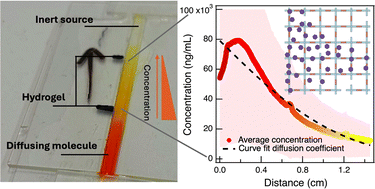
This work develops a technique to create and quantify tethered molecular concentration gradients in a hydrogel using a flow chamber. This device is designed to enable isotropic scaffold swelling, nutrient diffusion and real-time microrheological measurements. A hydrogel is first photopolymerized in the flow chamber ensuring that the mechanical properties of the hydrogel across samples are the same prior to molecular concentration gradient creation. Then molecules are passively diffused into the scaffold and a second photopolymerization tethers the concentration gradient into the material. This technique creates in vitro mimics of aspects of biological environments, such as the environment around a hydrogel implanted in the body for cell delivery. We use a well-defined synthetic scaffold with a poly(ethylene glycol) (PEG)-norbornene backbone cross-linked with a matrix metalloproteinase (MMP)-degradable peptide, a standard material for cell encapsulation. The method to tether molecular concentration gradients is validated using a fluorescent PEG-thiol (FITC-PEG-SH), an ideal polymer. We first create a calibration curve by measuring the fluorescence intensity of hydrogels with known uniform concentrations of the tethered fluorescent molecule. The calibration curve is used to calculate spatial concentration from measured fluorescence intensity in hydrogels with polymer or protein concentration gradients. FITC-PEG-SH is diffused through our hydrogel in a flow chamber for 6, 24 and 48 hours. We make consistent gradients and quantify the concentration of the fluorescent molecule every 25 µm along the material. Next, we make tethered concentration gradients of tumor necrosis factor-α (TNF-α), a pro-inflammatory cytokine found in the wound environment, after 24 hours of diffusion. These gradients are consistent when normalized by the concentration at the edge of the hydrogel, which varies due to pore clogging. From both molecular concentration gradients, we calculate an effective diffusion coefficient that is the same order of magnitude as the value calculated using the multiscale diffusion model. Significant advances made with this technique include limited confinement of the material, which enables isotropic swelling and facile nutrient diffusion, the ability to image through the device and the same hydrogel rheological properties across samples. This technique can be used in future work to characterize cell-laden hydrogels which present the same physical cues to cells and tethered concentration gradients of chemical cues using microrheology.
- This article is part of the themed collection: Soft Matter Open Access Spotlight 2026
 Please wait while we load your content...


