


 PLATFORM UPDATE:


Drug & virus transport across biological barriers: interactions, diffusion, partitioning, permeability, and selectivity
 a
and
Michael A.
Bevan
*a
a
and
Michael A.
Bevan
*a
Abstract
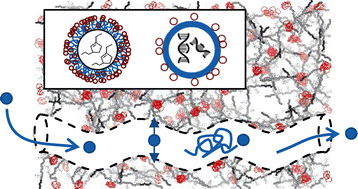
Biological barriers protect the human body by selectively blocking foreign material. Designing particles with coatings that efficiently transport across these barriers can increase the effectiveness and feasibility of advanced therapeutics. In particular, the mucus barrier protects the intestines, lungs, eyes, etc., complicating oral, inhaled, or ocular drug delivery. Heuristics for particle design are currently limited to the rate of diffusion within the barrier. Relying on first-principles theories for colloidal scale interactions, a cohesive model of the transport of particles through biological barriers is developed based on the barrier permeability, which incorporates essential contributions from both partitioning and diffusion. Analytical models are developed to predict partition coefficients based on particle–pore interaction potentials. Particle–pore hydrodynamics are considered to predict average diffusivities within mucus barriers. We show that kT-scale attractive interactions, that are either specific or non-specific, can yield optimal delivery of larger particles, to increase the mass flux across mucus barriers by an order of magnitude, and enable delivery of macromolecular cargo, due to enhanced partitioning. Our model indicates drug particle design rules to achieve transport rates comparable to or exceeding what is possible by viruses with highly evolved chemical and physical characteristics.
- This article is part of the themed collection: Soft Matter Open Access Spotlight 2026
 Please wait while we load your content...


