


 PLATFORM UPDATE:


Modular coupling of iron nanozymes and natural enzymes in responsive microgel reactors for enhanced cascade catalysis

Abstract
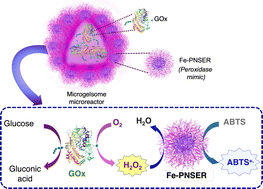
The modular integration of natural enzymes with synthetic nanozymes provides a promising strategy for creating hybrid catalytic systems with high efficiency and adaptability. However, achieving precise spatial organization and responsive control within a unified scaffold remains challenging. Herein, we report a Pickering emulsion-guided approach to fabricate responsive microgel-laden microcapsules, termed microgelsomes (MGC). Using oil–water emulsion droplets as templates, catalytic Fe3O4 nanoparticle-loaded poly(N-isopropylacrylamide-co-serine) microgels (Fe–PNSER) were assembled at the interface to form microcapsules that act as catalytic reactors. By incorporating enzymes in the aqueous core and Fe3O4 nanoparticles within the microgel membrane, self-contained chemo-enzymatic cascade reactors with tightly coupled reaction pathways were constructed. Using a glucose oxidase (GOx)/Fe–PNSER cascade as a model reaction, these multicompartment reactors showed roughly two-fold higher efficiency than homogeneous systems or simple mixtures of the same components, highlighting the advantage of spatially organized hybrid catalysis. The system also offers tunable properties, robustness, and compatibility for integrating diverse catalytic functions. This work provides a versatile and scalable platform for designing next-generation hybrid reactors with combined structural precision and functional synergy.
 Please wait while we load your content...


